What Is GEO? The SMB Guide to Getting Found in ChatGPT and Perplexity
TL;DR
GEO (Generative Engine Optimization) is how you get your brand recommended by AI search tools like ChatGPT and Perplexity. Unlike traditional SEO, GEO focuses on entity authority, structured content, and citation-worthy claims. Most SMBs aren't doing it yet — which means there's a window to get ahead.
According to research from Princeton, Georgia Tech, and the Allen Institute, websites that apply Generative Engine Optimization techniques see up to 40% more visibility in AI-generated responses. If your business depends on being found online, GEO is no longer optional — it is the next layer of search strategy, and most small businesses have never heard of it.
The Problem: Your SEO Is Working, But Your Leads Are Dropping
You have done the work. You have optimized title tags, published blog posts, built backlinks. Your Google rankings look fine. But something is off — fewer form fills, fewer calls, fewer demo requests. The traffic numbers may even be stable, but the quality is dropping.
Here is what is happening: your potential customers are not clicking through Google results the way they used to. Instead, they are asking ChatGPT, Perplexity, Gemini, Claude and Grok for recommendations. These AI tools synthesize answers from across the web and present them directly. If your brand is not in those synthesized answers, you are invisible to a growing segment of buyers.
Gartner projected that traditional search engine volume would drop 25% by 2026 due to AI chatbots and virtual agents. We are living in that prediction right now. The buyers who used to find you through a Google search are increasingly finding answers — and competitors — through AI-generated responses instead.
This is not a future problem. It is a right-now problem.
What Is GEO, Exactly?
GEO stands for Generative Engine Optimization. It is the practice of structuring your online presence so that large language models (LLMs) like GPT-4, Claude, and Gemini are more likely to reference, recommend, and cite your brand when users ask relevant questions.
Traditional SEO optimizes for search engine crawlers and ranking algorithms. GEO optimizes for the AI models that are now sitting between your content and the end user. The difference matters because LLMs do not rank pages — they synthesize information. They pull from multiple sources, weigh authority and relevance differently than Google does, and generate a single narrative response. Your brand either shows up in that narrative or it does not.
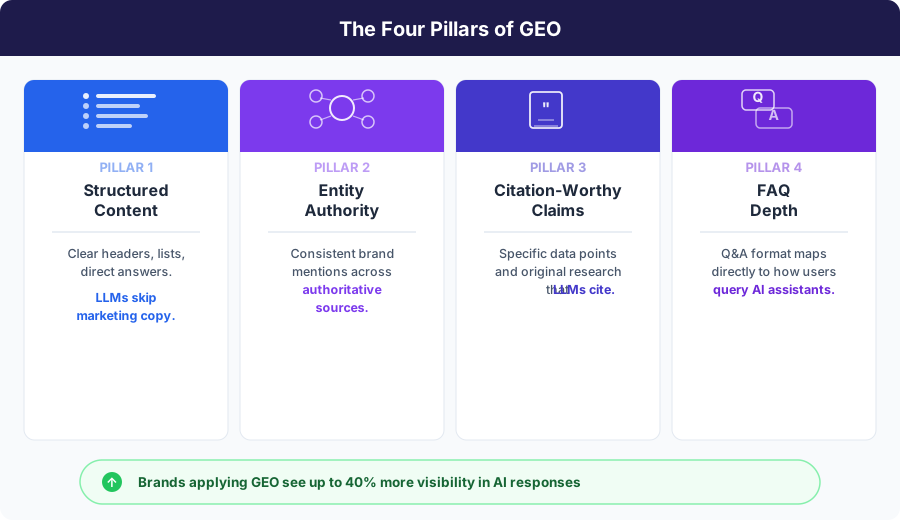
GEO encompasses several practices:
Structured content that LLMs can parse. AI models favor content that is clearly organized with headers, lists, and direct answers to common questions. Walls of marketing copy get ignored. Content that directly answers specific questions in plain language gets cited.
Entity authority. LLMs build internal representations of brands and entities based on how frequently and consistently they appear across authoritative sources. If your brand is mentioned on industry sites, directories, and publications in a consistent way, AI models are more likely to surface you.
Citation-worthy claims. When your content includes specific data points, original research, or unique frameworks, LLMs are more likely to reference it. Generic content that restates what everyone else says gets filtered out.
FAQ and knowledge-base depth. AI tools pull heavily from FAQ-style content because it maps directly to user questions. Businesses with comprehensive, well-structured FAQ pages have a significant advantage in AI search visibility.
The Adventyx Angle: Measuring and Improving Your AI Visibility
The biggest challenge with GEO is that most businesses have zero visibility into how AI tools perceive their brand. You can check your Google ranking in seconds. But how do you know if ChatGPT recommends you when someone asks "What's the best [your category] for small businesses?"
This is exactly what Adventyx was built to solve. Adventyx is an AI search visibility platform designed specifically for SMBs. It monitors how leading AI models — ChatGPT, Perplexity, Gemini, and others — respond to queries relevant to your business. It shows you where you are being recommended, where your competitors are showing up instead, and what specific changes to your content and online presence will improve your AI visibility.
Think of it as a rank tracker, but for the AI search era. Instead of tracking keyword positions on Google, Adventyx tracks whether AI engines cite your brand, how often, in what context, and how that compares to your competitors.
The platform also provides actionable recommendations based on how LLMs actually process your content. It identifies gaps in your structured data, FAQ coverage, entity consistency, and content authority — the factors that determine whether an AI model mentions you or skips over you entirely. And then, it creates assets that will make your content more visibile to LLMs.
One Thing You Can Do Today
Here is a concrete step you can take right now, before you sign up for any tool or hire any consultant:
Run the "brand mention" test across three AI tools.
- Open ChatGPT, Perplexity, and Google Gemini.
- Ask each one: "What are the best [your product/service category] companies for small businesses?"
- Ask each one a more specific version: "What [your product/service] should I use if I need [your key differentiator]?"
- Document whether your brand appears in any of the responses.
- Document which competitors appear instead.
This takes about 10 minutes and gives you an immediate baseline. If your brand does not appear in any of the responses, you now have a clear picture of the GEO gap you need to close. If it appears inconsistently, you know which AI platforms need the most attention.
Most SMB owners who run this test are surprised by the results. Brands that rank well on Google are frequently absent from AI-generated recommendations. The two ranking systems operate on different logic, and success in one does not guarantee success in the other.
What Comes Next
GEO is not a replacement for SEO — it is an addition to it. The businesses that will win in the next two years are the ones that optimize for both traditional search and AI-generated search simultaneously. The good news is that many GEO best practices (clear content structure, authoritative sourcing, comprehensive FAQs) also improve your traditional SEO.
The bad news is that most SMBs are not tracking AI visibility at all, which means they are flying blind while their competitors may already be optimizing for it.
Get your free AI Visibility Audit at adventyx.ai to see exactly where your brand stands in AI search results — and get a concrete roadmap for improving it.