Is Your Brand Invisible to ChatGPT? Here's How to Find Out in 10 Minutes
TL;DR
You can audit your AI search visibility in 10 minutes by running 5-8 queries across ChatGPT, Perplexity, and Gemini. Most SMBs score below 20% visibility. The fix starts with FAQ-based content that matches how people ask AI assistants for help.
A 2025 Authoritas study found that only 1.6% of ChatGPT citations link back to the original source — meaning even when an AI model uses your content to form an answer, the user almost never clicks through to your site. Your brand can be a data source for AI and still be commercially invisible to the person asking the question.
The Problem: You Do Not Know What ChatGPT Says About You
Here is a scenario that is playing out across thousands of small businesses right now: a potential customer opens ChatGPT and types "What's the best project management tool for a 10-person marketing team?" or "Which CRM should I use if I'm a solo consultant?" or "What accounting software works best for e-commerce businesses?"
ChatGPT generates a confident, detailed answer. It recommends two or three brands by name. It explains why each one fits the use case. The user reads the answer, nods, and goes directly to one of those recommended brands. No Google search. No clicking through ten blue links. No visiting your carefully optimized landing page.
If your brand was not in that AI-generated recommendation, you just lost a potential customer — and you have absolutely no idea it happened. There is no analytics dashboard showing you "lost AI impressions." There is no notification that says "ChatGPT recommended your competitor instead of you 47 times this week."
This is the visibility gap that is quietly eroding lead generation for SMBs. According to Gartner, traditional search volume was projected to decline 25% by 2026 due to AI chatbots. That decline is not theoretical anymore. It is reflected in the pipeline numbers that marketing managers are staring at right now, trying to explain why cost-per-lead is climbing even though SEO metrics look healthy.
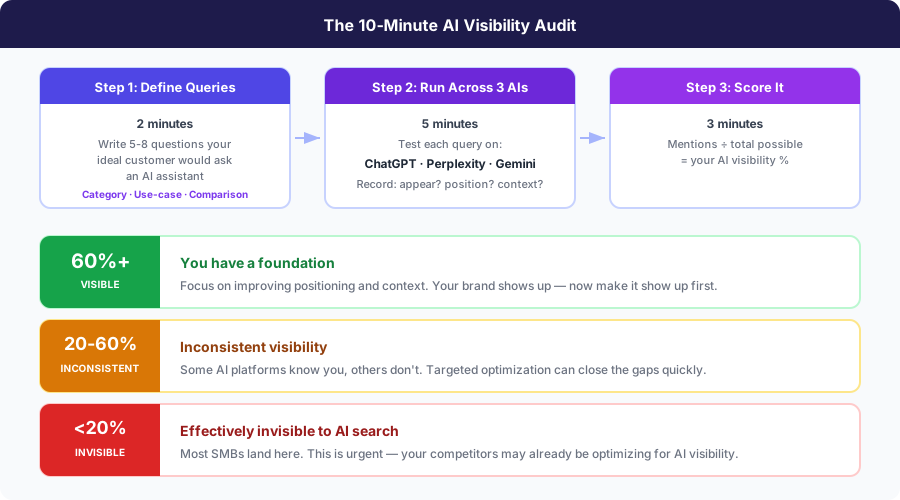
The 10-Minute AI Visibility Audit
You do not need a tool to get your first baseline. Here is a structured process you can run right now to understand how AI search engines perceive your brand.
Step 1: Define Your Query Set (2 minutes)
Write down five to eight questions that your ideal customer would ask an AI assistant before buying. Be specific. Not "best CRM" but "best CRM for freelance consultants under $50/month." Think about:
- Category queries: "What are the best [your category] tools?"
- Use-case queries: "What [your category] should I use if I need [specific feature]?"
- Comparison queries: "How does [your brand] compare to [competitor]?"
- Problem queries: "How do I solve [problem your product addresses]?"
Step 2: Run the Queries Across Three AI Platforms (5 minutes)
Open ChatGPT, Perplexity, and Google Gemini. Ask each platform your five to eight questions. For each response, record:
- Does your brand appear? (Yes / No)
- In what position? (First recommendation, mentioned in a list, or buried at the end)
- What context? (Recommended positively, mentioned neutrally, or compared unfavorably)
- Which competitors appear instead?
Use a simple spreadsheet. Rows are your queries, columns are the three platforms.
Step 3: Score Your Visibility (3 minutes)
Count how many times your brand appeared out of the total possible mentions (queries multiplied by platforms). That percentage is your rough AI visibility score.
- Above 60%: You have a foundation. Focus on improving positioning and context.
- 20-60%: Inconsistent visibility. Some platforms know you, others do not.
- Below 20%: You are effectively invisible to AI search. This is urgent.
Most SMBs who run this audit for the first time land below 20%. That is not a failure of your marketing — it is a reflection of the fact that AI search optimization is a new discipline that most businesses have not addressed yet.
Why Your Google Rankings Do Not Predict Your AI Visibility
This is the part that confuses most marketing managers. You can rank on the first page of Google for your target keywords and still be completely absent from AI-generated recommendations. Here is why:
LLMs do not crawl and index like Google. They are trained on large datasets and updated periodically. The information cutoff, the training data composition, and the RAG systems each platform uses all determine what they know about your brand.
Authority signals differ. Google weighs backlinks heavily. LLMs weigh consistency, specificity, and entity recognition. If your brand is mentioned consistently across multiple authoritative sources with clear descriptions of what you do, LLMs are more likely to surface you. A strong backlink profile does not automatically translate.
Content format matters differently. Google rewards long-form content, keyword optimization, and technical SEO. LLMs favor structured content, FAQ-based content, and specific claims with data points. A page optimized purely for Google may be structured in a way that LLMs skip over.
Recency is handled differently. Google re-crawls frequently. LLMs have training cutoffs and may supplement with real-time retrieval (like Perplexity does). Your latest product update might be reflected on Google within days but take months to appear in ChatGPT's training data.
The Adventyx Approach: Continuous AI Visibility Monitoring
The 10-minute audit gives you a snapshot, but AI search visibility is not static. Models update their training data. Competitors optimize their content. New queries emerge as your market evolves. A one-time manual audit becomes outdated within weeks.
Adventyx automates this entire process. The platform continuously monitors how ChatGPT, Perplexity, Gemini, and other AI engines respond to queries relevant to your business. Instead of manually checking five queries across three platforms, Adventyx tracks hundreds of relevant queries and shows you:
- Your AI visibility score across all major AI platforms, updated continuously.
- Competitor comparison showing who AI models recommend when they do not recommend you, and how your visibility stacks up against specific competitors.
- Content gaps identifying which queries you are missing and what content changes would improve your visibility for those specific queries.
- Trend tracking showing whether your AI visibility is improving or declining over time, correlated with content changes you make.
- Optimization creating assets that will ensure that your website, products and services are visible to LLMs.
The platform is built specifically for SMBs. You do not need an enterprise budget or a dedicated AI search team. Adventyx gives you the same visibility intelligence that large brands are paying agencies tens of thousands of dollars to compile manually.
One Concrete Step Beyond the Audit
After you have run your 10-minute audit, here is the single highest-impact action you can take today:
Create or update your FAQ page with 15 to 20 questions that match how people actually ask AI assistants for help.
Look at the queries you used in your audit. Now write FAQ entries that directly answer those questions with your brand explicitly mentioned. For example, instead of a generic FAQ like "What features does our platform include?" write "Why do freelance consultants choose [Your Brand] for CRM?" and answer it with specific, citation-worthy claims.
AI models pull heavily from FAQ-based content because the question-and-answer format maps directly to how users interact with chatbots. A well-structured FAQ page is one of the fastest ways to improve your AI visibility without overhauling your entire content strategy.
See Your Real AI Visibility Score
The manual audit is a start, but it only scratches the surface. You checked a handful of queries on three platforms. Your actual AI visibility landscape involves hundreds of relevant queries across multiple models that update constantly.
Book a demo at adventyx.ai to see your brand's full AI visibility score, compare against your competitors, and get a prioritized action plan for improving your presence in AI-generated search results.