Google SEO vs. AI Search: Why Playing by the Old Rules Is Costing You Customers
TL;DR
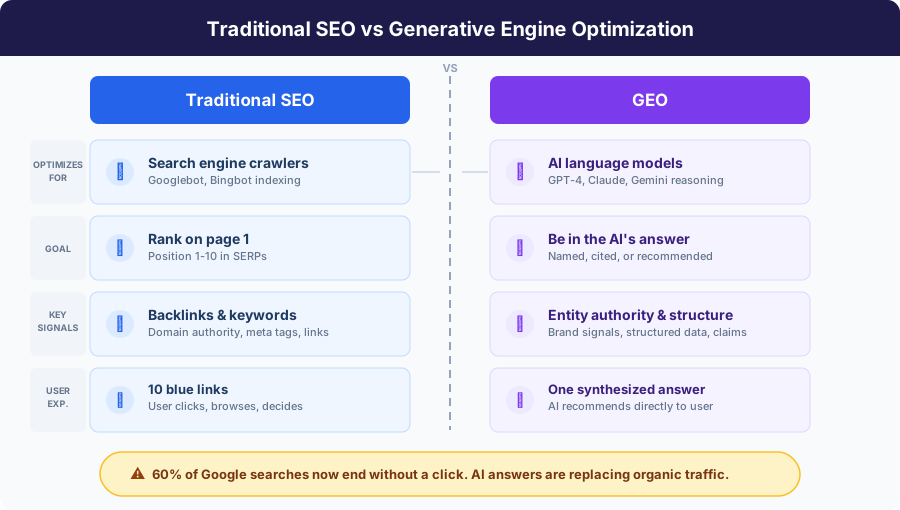
Traditional SEO optimizes for where you rank. GEO optimizes for whether you're in the AI's answer at all. Nearly 60% of Google searches already end without a click, and AI Overviews are accelerating that trend. You need a parallel strategy for AI search — focusing on structured data, entity recognition, and content formats that LLMs prefer to cite.
According to Gartner, organic search traffic to commercial websites will drop 25% by 2026 as AI-powered answer engines like ChatGPT, Perplexity, and Google's AI Overviews serve direct answers instead of links. If your entire digital strategy still revolves around ranking on page one of Google, you are optimizing for a shrinking channel.
The Problem: Your SEO Playbook Was Written for a Different Era
For more than a decade, the formula was straightforward. Research keywords, create optimized content, build backlinks, climb the rankings, and watch the leads roll in. That playbook worked because Google sent users to your website. The transaction was simple: Google provided discovery, you provided the content, and the user clicked through.
That transaction is breaking down.
AI search engines do not send users to your website. They synthesize answers from multiple sources and present them directly inside the chat interface. A prospective customer who once would have typed "best CRM for small business" into Google and clicked your comparison page now asks ChatGPT the same question and gets a synthesized answer without ever seeing your domain.
The data confirms this shift is accelerating. A 2025 study by Rand Fishkin's SparkToro found that nearly 60% of Google searches already end without a click to any website, up from 50% just two years prior. AI answer engines push that number even higher because the entire user experience is designed to keep people inside the tool.
This means your carefully optimized blog posts, landing pages, and pillar content may still rank on Google — but fewer people are making it to Google in the first place. And when they do, Google's own AI Overviews often answer the query before the user scrolls to the organic results.
The Adventyx Angle: Visibility Now Means Being in the AI's Answer
The rules have not just changed — the game itself is different. Traditional SEO optimizes for where you rank on a results page. AI search visibility is about whether your brand, your data, and your expertise are part of the answer the AI generates.
These are fundamentally different problems requiring different strategies.
When ChatGPT recommends three CRM platforms for small businesses, it is not pulling from a ranked list. It is synthesizing information from training data, web crawls, and RAG pipelines. The brands that show up in those answers are the ones whose structured content is cited and authoritative enough that the AI treats them as reliable sources.
This is exactly what Adventyx was built to solve. Our AI search visibility platform analyzes how your brand appears — or fails to appear — across major AI answer engines. We show you which queries mention your competitors but not you, which of your pages are being cited as sources, and where your content gaps are letting other brands dominate the AI-generated answers in your category. And we generate content and assets that improve your visibility in these AI search queries.
Traditional SEO tools tell you where you rank on Google. Adventyx tells you whether you exist in the answers your customers are actually reading. And it helps you to show up in those answers.
Practical Value: One Thing You Can Do Today
Here is a concrete exercise you can do in the next fifteen minutes to understand your exposure.
Open ChatGPT, Perplexity, and Google's AI Overview. Type in the five most important commercial queries for your business — the ones that drive revenue, not vanity traffic. For example, if you sell project management software, try "best project management tool for remote teams" or "project management software under $20 per user."
For each query, document three things:
- Is your brand mentioned? Not linked — mentioned. In AI search, a mention in the synthesized answer is the new equivalent of a page-one ranking.
- Which competitors are mentioned? This tells you who the AI considers authoritative in your space.
- What sources does the AI cite? Perplexity shows its sources explicitly. This reveals what content formats and domains the AI trusts.
If your brand does not appear in any of the five answers, you have an AI visibility gap. That gap is costing you customers right now, and it will widen as AI search adoption grows. According to Reuters Institute, over 30% of U.S. adults used an AI chatbot for search-like tasks at least weekly in late 2025, a figure that has only climbed since.
The fix is not to abandon SEO. Google still matters. But you need a parallel strategy for AI search visibility — one that focuses on structured data, authoritative sourcing, entity recognition, and content formats that AI models prefer to cite.
Optimizing for AI search means thinking about schema markup alongside your traditional on-page SEO, and understanding that zero-click searches are the new reality for a majority of queries.
Your Next Step
Understanding the problem is the first step. Measuring it is the second.
Get your free AI Visibility Audit at adventyx.ai. In under five minutes, you will see exactly where your brand stands across the AI answer engines that are replacing traditional search — and what to do about it.