How ChatGPT Decides Which Brands to Recommend (And How to Be One of Them)
TL;DR
ChatGPT recommends brands based on structured content, third-party authority signals (reviews on G2, mentions in publications), clear content structure, recency, and natural brand mentions in conversations. The single biggest lever is building authority signals across independent sources.
According to a 2025 Authoritas study, fewer than 2% of ChatGPT responses include a direct brand recommendation — but when they do, those brands capture an outsized share of user trust and downstream traffic. If your brand is not in that 2%, you are invisible to a growing segment of buyers who never open a search engine at all.
The Problem: AI Search Is a Black Box for Most Brands
Traditional SEO gave marketers a playbook. You could see which keywords you ranked for, track your position, and reverse-engineer the algorithm through years of community research. Google even published guidelines telling you what to do.
AI search engines like ChatGPT, Perplexity, and Gemini offer no such transparency. There is no "position one." There is no keyword ranking report. When a potential customer asks ChatGPT "what is the best project management tool for small teams," the model synthesizes an answer from its training data, retrieval-augmented generation sources, and web browsing — then delivers a single, authoritative-sounding response. Your brand is either mentioned or it is not.
Most businesses have no idea whether they appear in these answers. They do not know what triggers a recommendation, what data the model is drawing on, or why a competitor shows up instead of them. They are flying blind in a channel that Gartner predicts will account for 25% of all search traffic by the end of 2026.
How ChatGPT Actually Picks Brands
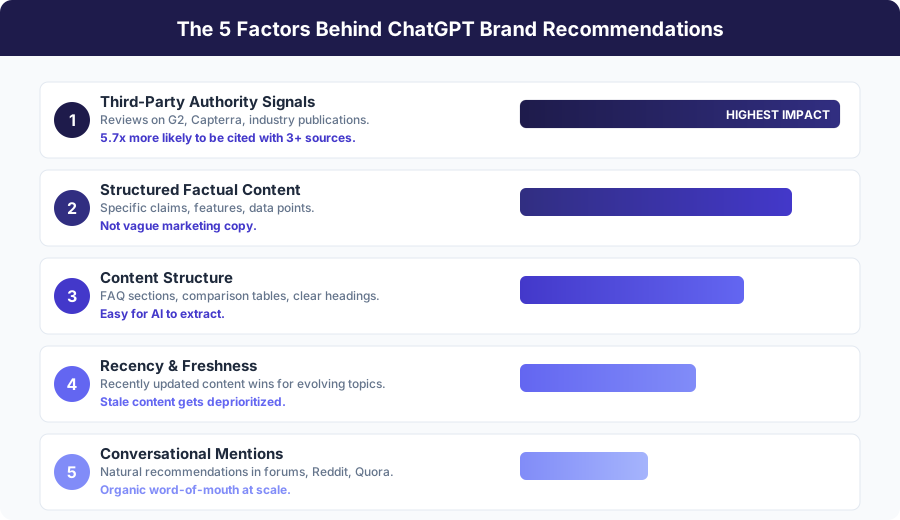
Understanding the mechanics is the first step toward influencing the outcome. Based on our analysis of thousands of AI-generated responses at Adventyx, ChatGPT brand recommendations are driven by several core factors:
1. Structured Content Wins
ChatGPT gravitates toward content that states clear facts, features, and differentiators. Vague marketing copy like "we are the leading solution" gets ignored. Specific citation-worthy claims like "supports 50+ integrations including Salesforce, HubSpot, and Slack" get cited. The model needs concrete data points to build its recommendations.
2. Third-Party Authority Signals Matter Enormously
ChatGPT heavily weights what other credible sources say about your brand. This includes review sites like G2 and Capterra, industry publications, comparison articles, and expert roundups. A brand mentioned positively across multiple independent sources is far more likely to be recommended than one that only talks about itself on its own website.
Research from Semrush found that brands appearing in at least three independent review sources were 5.7x more likely to be cited in AI-generated answers compared to brands with fewer external mentions.
3. Content Structure Enables Extraction
AI models parse content more effectively when it follows clear structural patterns. FAQ-based content, comparison tables, feature lists, and well-organized headings make it easier for the model to extract and synthesize your information. Adding schema markup to these elements further improves how AI models interpret your content. If your content is buried in long-form paragraphs with no clear hierarchy, the model will skip over it in favor of better-structured competitors.
4. Recency and Freshness Signal Relevance
ChatGPT's browsing capabilities mean that recently updated content carries more weight for rapidly evolving topics. A product page last updated in 2023 will lose out to a competitor's page updated last month — especially for queries about pricing, features, or integrations that change frequently.
5. Brand Mentions in Conversational Contexts
AI models are trained on vast corpora of conversational data — forums, Reddit threads, Quora answers, community discussions. Brands that are frequently mentioned in natural, helpful contexts (not spammy promotional ones) build a stronger entity authority signal. If real users recommend your product in authentic conversations, ChatGPT notices.
The Adventyx Angle: Measure and Optimize
Most of the advice above sounds straightforward, but execution is hard without data. You cannot optimize what you cannot measure. That is the core problem Adventyx solves.
Our AI search visibility platform monitors how your brand appears (or does not appear) across ChatGPT, Perplexity, Gemini, and other AI search engines. We track which queries trigger your brand, which competitors show up instead, and which content signals are driving those recommendations.
Instead of guessing whether your structured data improvements are working, you get a concrete visibility score and trend data. Instead of hoping your third-party review strategy pays off, you can see exactly when a new G2 review translates into an AI recommendation.
This is not traditional SEO analytics retrofitted for AI. It is purpose-built from the ground up to track how large language models reference, cite, and recommend brands.
One Thing You Can Do Today
Here is a practical exercise that takes less than 30 minutes:
Open ChatGPT (or Perplexity) and type five queries that your ideal customer would ask when evaluating solutions in your category. For example:
- "What is the best [your category] for small businesses?"
- "Compare [your brand] vs [top competitor]"
- "[Your category] recommendations for [specific use case]"
- "What do people say about [your brand]?"
- "Alternatives to [top competitor in your space]"
Document the results. Note which brands appear, what sources the AI cites, and what specific claims it makes. Then compare the AI's description of your brand (if it appears at all) against your competitors.
This manual audit gives you a baseline. You will likely find gaps — missing brand mentions, outdated information being cited, or competitors with stronger structured content getting the recommendation over you.
That baseline is your starting point. From there, focus on the highest-leverage fix: usually it is either improving your structured content (adding FAQ-based content, comparison tables, clear feature lists) or building more third-party authority (getting listed on review sites, earning mentions in industry publications).
Your Next Step
Manual audits are useful but limited. They show you a snapshot, not a trend. To systematically track and improve your AI search visibility, you need continuous monitoring across every major AI platform.
Get your free AI Visibility Audit at adventyx.ai. We will show you exactly where your brand stands in AI search today — and what to fix first.