Perplexity vs. ChatGPT vs. Google AI: Where Should Your Brand Focus First?
TL;DR
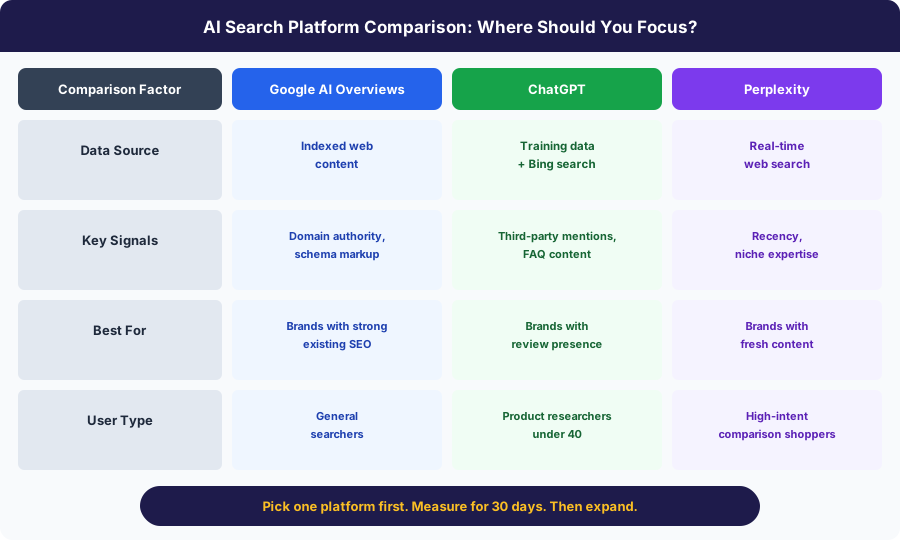
Each AI search platform works differently. Google AI Overviews favor existing SEO strength + schema markup. ChatGPT weights third-party mentions and FAQ content. Perplexity rewards recency and niche expertise. Pick one platform to optimize first based on your audience, measure for 30 days, then expand.
A Rand Fishkin analysis found that Google AI Overviews now appear on over 40% of informational queries, yet fewer than 12% of the cited sources overlap with the traditional top-10 organic results. The brands winning in AI search are not necessarily the ones winning in classic SEO — and if you are spreading your efforts equally across every AI platform, you are almost certainly wasting budget.
The Problem: Three AI Search Engines, Three Different Games
If you are a marketing manager or SEO professional, you have probably noticed that your brand shows up differently — or not at all — depending on which AI search tool your customer uses. A query about "best CRM for real estate agents" might return completely different brand recommendations on Perplexity, ChatGPT, and Google AI Overviews.
This is not a bug. Each platform pulls from different data sources, weighs authority signals differently, and serves fundamentally different user intents. Treating them as interchangeable is the most common mistake brands make in AI search optimization.
The result: scattered efforts, unclear ROI, and a nagging feeling that AI search matters but no clear strategy for capturing it.
How Each Platform Works (And Why It Matters)
Google AI Overviews: The Hybrid Giant
Google AI Overviews draw primarily from indexed web content — the same corpus that powers traditional search, but filtered and synthesized by Gemini. Because Google has the deepest web index and the strongest user intent signals from decades of search data, AI Overviews tend to favor:
- Content already ranking in the top 20 organic results. Google's existing ranking signals still matter here — domain authority, backlinks, and topical relevance influence what gets pulled into the AI Overview.
- Structured data and schema markup. FAQ schema, product schema, and how-to markup give Google's AI a clear extraction path.
- Fresh, comprehensive content. Long-form pages that thoroughly answer a query are more likely to be synthesized than thin content.
If your brand already has a strong traditional SEO presence, Google AI Overviews may be your fastest win. The gap between "ranking on page one" and "cited in the AI Overview" is smaller here than on any other platform.
ChatGPT: The Conversational Authority
ChatGPT operates differently. Its recommendations are shaped by its training data (a broad corpus of web text, books, and code), real-time web browsing via Bing, and its RAG pipeline. Key differences from Google:
- Third-party mentions carry enormous weight. ChatGPT synthesizes across sources. A brand mentioned positively on G2, TechCrunch, Reddit, and a niche industry blog has a much stronger signal than a brand with a great website but limited external presence.
- Conversational, natural-language content performs well. ChatGPT is optimized for dialogue. Content written in a natural Q&A format — actual FAQ-based content, comparison guides, "versus" articles — maps well to how users query ChatGPT.
- Brand consistency across the web matters. Conflicting information (different pricing on your site vs. a review from 2024) creates confusion in the model and may cause it to hedge or omit your brand entirely.
According to a 2025 SparkToro study, 37% of U.S. adults under 35 now use ChatGPT as their first search tool for product research. If your target audience skews younger or more tech-savvy, ChatGPT visibility is not optional.
Perplexity: The Citation-First Researcher
Perplexity differentiates itself by showing its sources inline — every claim is footnoted with a link. This creates a unique dynamic:
- Source credibility is visible to the user. Being cited by Perplexity means your brand and URL appear directly in the answer. Users can (and do) click through. Perplexity drives measurable referral traffic in a way that ChatGPT often does not.
- Recency is heavily weighted. Perplexity's real-time search means recently published or updated content has a significant advantage. A blog post from last week will beat a comprehensive guide from last year if the query is time-sensitive.
- Domain authority matters, but niche expertise wins. Perplexity cites specialized industry sources more frequently than generic high-DA sites. A focused SaaS review blog with 5,000 monthly visitors may outperform Forbes for a niche product query.
Perplexity's user base is smaller than Google or ChatGPT, but its users tend to be high-intent researchers — exactly the audience that converts.
The Adventyx Angle: Stop Guessing, Start Measuring
The strategic question is not "should I optimize for AI search?" — it is "which AI search platform should I prioritize given my audience, my current visibility, and my resources?"
That question is impossible to answer without data. And that is exactly what Adventyx provides.
Our platform monitors your brand's visibility across all three major AI search engines simultaneously. We track:
- Which queries trigger your brand on each platform (and which trigger your competitors instead)
- Source attribution patterns — what structured content and external mentions are driving your AI recommendations
- Platform-specific gaps — you might be well-represented on Google AI Overviews but invisible on ChatGPT, or vice versa
- Trend data over time — so you can measure whether your optimization efforts are actually working
Instead of running manual queries across three platforms and trying to synthesize the results yourself, Adventyx gives you a unified dashboard with actionable insights specific to each AI search engine. And then Adventyx generates content and assets to increase your visibility in these AI search queries
A Framework for Prioritizing Your AI Search Strategy
Here is a practical framework you can use today to decide where to focus first:
Start with Google AI Overviews if:
- You already rank in the top 20 for your target keywords
- Your content has strong schema markup
- Your audience uses Google as their primary search engine
- You want the fastest path to AI visibility with existing SEO assets
Start with ChatGPT if:
- Your brand has strong third-party mentions (reviews, press, community discussions)
- Your target audience skews under 40 or is tech-forward
- You have robust FAQ-based content and comparison content
- You want to capture product-research queries
Start with Perplexity if:
- You have recently published, high-quality content
- You are in a niche where specialized expertise beats domain authority
- You want measurable referral traffic (not just brand mentions)
- Your buyers are researchers who compare before purchasing
Most brands should pick one platform to optimize first, measure results for 30 days, then expand. Trying to optimize for all three simultaneously with limited resources leads to mediocre results everywhere.
Your Next Step
You do not need to guess which AI search platform matters most for your brand. We can show you.
Book a demo at adventyx.ai and see exactly where your brand appears — and where it is missing — across ChatGPT, Perplexity, and Google AI Overviews. Your AI visibility score includes platform-specific breakdowns so you know precisely where to focus first.