Why Your Website Traffic Is Down Even Though Your Google Ranking Hasn't Changed
TL;DR
Your rankings haven't changed but traffic is down because AI search tools are answering your users' queries before they click through. Nearly 60% of Google searches already end without a click. The fix isn't better SEO — it's adding AI search visibility to your strategy so your brand appears in the answers users are actually reading.
According to a 2025 study by Rand Fishkin and SparkToro, nearly 60% of Google searches now end without a click to any website. That number is growing every quarter. If your traffic is declining while your rankings hold steady, you are not imagining things — and you are not alone. The search landscape has fundamentally changed, and the explanation is hiding in plain sight.
The Problem: Rankings Are No Longer a Reliable Proxy for Traffic
For over two decades, the logic was simple. Rank higher, get more clicks. If your position on Google stayed the same, your traffic should stay the same. That assumption is now broken.
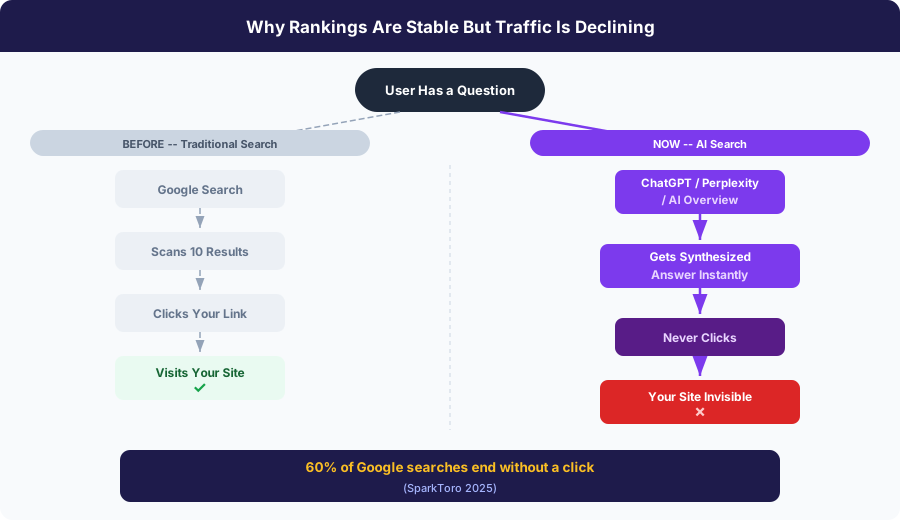
Here is what is actually happening. Google's AI Overviews, ChatGPT, Perplexity, and other AI-powered search tools are answering user queries directly — without sending users to your website. A user searches for something you rank well for, gets a synthesized answer at the top of the results page (or inside an AI chat interface), and never scrolls down to your blue link.
This is not a hypothetical scenario. Gartner predicted that organic search traffic to websites would drop 25% by 2026 due to AI-powered search. We are now living in that prediction. The traffic you are losing is not going to a competitor. It is being absorbed by AI tools that extract your content and serve it as their own answer.
The effect is especially brutal for informational queries — the exact kind of content most SMBs invest in for SEO. How-to guides, comparison pages, FAQ content, and educational blog posts are the first to lose clicks because they are the easiest for AI to summarize. This is the rise of zero-click searches — queries that are fully resolved without the user ever visiting a website.
If you are a marketing manager watching your analytics dashboard with growing confusion, or an SEO professional whose client is asking why conversions are down despite stable rankings, this is the root cause. Your content is still being found. It is just not being clicked.
The Adventyx Angle: Visibility in AI Search Is the New Battleground
Traditional SEO tools measure where you rank on a search results page. They do not tell you whether AI tools are citing your brand, quoting your content, or recommending your product when users ask questions in ChatGPT, Perplexity, or Google's AI Overviews.
That gap is exactly what Adventyx was built to close.
Adventyx is an AI search visibility platform designed for SMBs. It monitors how your brand appears across AI-powered search experiences — not just traditional Google results. Using GEO (Generative Engine Optimization) principles, it tracks whether LLMs mention your brand, whether they link to your site, and how your visibility compares to competitors in AI-generated answers. And it generates structured content and assets to increase your visibility to these AI queries.
Think of it this way: if traditional SEO tools are your rearview mirror, Adventyx is your windshield. You need both, but only one shows you where you are actually headed.
The shift from click-based search to answer-based search is not a temporary blip. It is a structural change in how people find information online. Brands that recognize this early and optimize for AI search visibility will capture the attention that others are quietly losing. Brands that keep staring at their Google rankings while traffic evaporates will keep wondering what went wrong.
What You Can Do About This Today
Here is one concrete action you can take right now, before signing up for any tool or changing your content strategy.
Run a manual AI search audit. Open ChatGPT, Perplexity, and Google (with AI Overviews enabled). Type in 10 queries that your ideal customers would ask — queries where you currently rank well on traditional Google. For each query, note three things:
-
Does the AI-generated answer mention your brand by name? If not, the AI tool is using your content (or similar content) without attribution, and users never learn you exist.
-
Does the AI-generated answer link to your website? Some AI tools provide source links. Check whether yours appears. If it does not, even being "the source" of the information gets you zero traffic.
-
Is a competitor mentioned instead? This is the most painful finding, but the most actionable. If a competitor shows up in AI answers for queries you own in traditional search, they have already started optimizing for AI visibility and you have not.
Write down what you find. You will likely discover that for most of your high-value queries, your brand is invisible in AI search results — even when you rank on page one of Google. That gap between your Google rank and your AI visibility is where your missing traffic went.
This manual process gives you a snapshot, but it does not scale. You cannot check every query, every AI platform, every day. That is where automated monitoring comes in, and that is the core of what Adventyx provides. But the manual audit is a powerful first step because it makes the problem tangible and impossible to ignore.
Your Next Step
The traffic decline you are seeing is not going to reverse itself. AI search adoption is accelerating — Similarweb reports a 250% increase in AI search tool usage over the past 18 months — and every month you wait is another month of invisible erosion.
Get your free AI Visibility Audit at adventyx.ai. It takes less than two minutes to set up, and you will see exactly where your brand stands across the AI search tools your customers are already using. No guessing, no manual spot-checks — just a clear picture of your AI search visibility and what to do about it.