What Happens When You Optimize for AI Search: A Before/After Breakdown
TL;DR
Most brands that rank well on Google are invisible in AI search — only 12% of page-one sites get cited in AI results. After optimization, brands typically see 15-30% AI citation rates within 60-90 days, new referral traffic from AI sources, and higher-converting leads because the AI pre-qualifies buyers with a recommendation.
A 2025 BrightEdge study found that only 12% of brands appearing on page one of Google are cited in AI-generated search results. That means 88% of businesses winning at traditional SEO are invisible in the fastest-growing search channel. Optimizing for AI search is not a theoretical exercise — it produces measurable, visible results. Here is exactly what changes when you do it.
The Problem: You Are Optimizing for a Search Experience That Is Shrinking
Most businesses are still pouring time and money into traditional SEO — keyword research, backlink building, meta tag optimization, content calendars built around search volume. None of that is wrong. But it is incomplete.
The way people search is splitting into two channels. Traditional search (type query, scan results, click a link) is one channel. AI search (ask a question, get a synthesized answer, maybe click a source link) is the other. According to data from Similarweb, AI search tools like ChatGPT and Perplexity saw a combined 250% increase in search-related usage over the past 18 months. Google's own AI Overviews now appear on roughly 30% of all queries.
If your optimization strategy only covers the first channel, you are playing on a shrinking field while ignoring the one that is expanding. The result is predictable: declining traffic, fewer leads, and a creeping sense that something is off even though your SEO metrics look fine.
The businesses that are pulling ahead right now are not the ones with the best backlink profiles or the highest domain authority. They are the ones who figured out how to get cited, quoted, and recommended by AI search tools — a discipline known as GEO (Generative Engine Optimization). And the difference between "before" and "after" is striking.
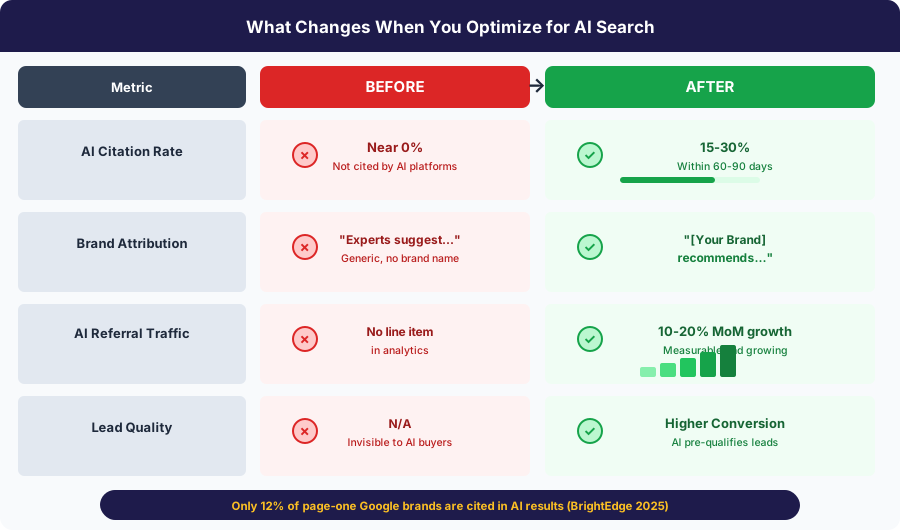
Before Optimization: The Invisible Brand
Here is what a typical SMB looks like in AI search before any optimization work.
AI Citation Rate: Near Zero. When users ask ChatGPT, Perplexity, or Google AI Overviews questions related to the brand's industry, the brand does not appear in the response. Competitors might. Generic sources like Wikipedia or large publications almost certainly do. But the SMB — even one ranking well on traditional Google — is absent.
Content Gets Used, Brand Gets Ignored. LLMs are trained on or retrieve web content. Your blog posts, guides, and product pages may be part of the training data or retrieval corpus. But without structural signals that help AI tools attribute information to your brand, the AI uses your knowledge without ever mentioning your name.
Zero Inbound From AI Channels. When you look at referral traffic, there is no line item for ChatGPT, Perplexity, or AI Overviews clicks. Not because the traffic is small — because it does not exist. Users in AI search channels never encounter your brand at all. These are zero-click searches where your content feeds the answer but your brand gets no credit.
Missed Commercial Intent Queries. When a potential customer asks an AI tool "What is the best [your category] tool for small businesses?" your product does not appear in the recommendation. This is the AI equivalent of not ranking for your most valuable commercial keywords — except there is no position #7 to work up from. You are simply not in the conversation.
After Optimization: What Actually Changes
Now here is what shifts when a brand systematically optimizes for AI search visibility using a platform like Adventyx.
AI Citation Rate Increases Measurably. Brands that optimize for AI visibility typically see their citation rate in AI-generated answers climb from near zero to appearing in 15-30% of relevant queries within 60-90 days. This is not a ranking — it is a presence metric. Either the AI mentions you or it does not, and optimization through citation-worthy claims and structured content directly influences that outcome.
Brand Attribution Replaces Anonymous Extraction. With proper schema markup, entity authority optimization, and content formatting aligned to how AI tools parse information, the AI starts attributing insights and recommendations to your brand by name. Instead of "experts suggest..." the AI says "[Your Brand] recommends..." That attribution is worth more than a backlink because it comes with implicit endorsement.
New Referral Traffic From AI Sources. Perplexity and Google AI Overviews both provide source links. Optimized brands see a new and growing referral channel appear in their analytics. Early data from Adventyx customers shows AI referral traffic growing 10-20% month-over-month once optimization is in place — a growth rate that traditional organic search has not matched in years.
Commercial Queries Start Converting. When AI tools recommend your product by name in response to buying-intent questions, the conversion path shortens dramatically. The user does not need to compare five websites. The AI already positioned you as a credible option. Brands using Adventyx have reported that leads from AI search channels convert at a higher rate than traditional organic leads because the AI pre-qualified them with a recommendation.
The Adventyx Angle: Monitoring and Optimizing in One Platform
The before/after shift described above does not happen by accident. It requires three things: visibility into where you currently stand, specific guidance on what to change, and ongoing monitoring to track progress.
Adventyx provides all three. The platform scans AI search tools continuously, measures your brand's citation rate and sentiment across AI-generated answers, identifies gaps where competitors appear and you do not, and provides actionable recommendations along with content and assets — not generic advice, but specific changes to your content, structured content, and entity signals that improve AI visibility.
Most SMBs cannot afford to manually audit their AI search presence every week across multiple platforms. Adventyx automates the monitoring and translates the data into a clear visibility score and prioritized action list. You see exactly where you stand, what changed since last week, and what to do next. And get content that will improve your visibility
One Thing You Can Do Today
Before committing to any platform, validate the opportunity for yourself. Pick your single highest-value commercial keyword — the one that drives the most revenue when someone searches for it. Now ask that exact query in ChatGPT, Perplexity, and Google with AI Overviews enabled.
Look at the AI-generated answer for each tool. Ask yourself:
- Does the answer mention my brand?
- Does it mention a competitor?
- If I were a buyer reading this answer, would I know my company exists?
If the answer to the first question is "no" for even one AI tool, you have a quantifiable gap between your traditional search presence and your AI search presence. That gap is going to widen every month as AI search adoption grows.
The brands closing that gap now are building an advantage that compounds over time — just like traditional SEO did a decade ago. The brands ignoring it will be playing catch-up later at a much higher cost.
See Your Before/After Potential
Book a demo at adventyx.ai and we will show you exactly where your brand stands in AI search today — your citation rate, your competitor comparison, and the specific optimizations that will move the needle. No generic playbook. Your brand, your queries, your data.
See your brand's AI visibility score at adventyx.ai.